Table of Contents

Money Burnout: How I’m Recovering Without Burning Myself Out
I didn’t stop blogging because I ran out of ideas.
I stopped because I was tired—mentally, financially, emotionally tired.
Somewhere along the way, I convinced myself that working harder would fix everything. If I just put in more hours, launched one more thing, pushed through one more late night, the money stress would ease up. Instead, it compounded. The exhaustion made every decision feel heavier, every number scarier, and every mistake louder.
This isn’t a post about budgeting hacks or financial glow-ups. It’s about what happens when money stress and burnout collide—and what recovery actually looks like when you stop trying to “win” and start trying to breathe.
If you’ve ever felt like you were running full speed just to stay in the same place, this is for you.
I’ve written before about slowing down and reassessing priorities during overwhelming seasons, especially when life and finances start pulling in opposite directions.
Where Things Started to Slip — Why It Happens Inside the Brain
How the cash crash sneaked up on us...
Nothing dramatic exploded into my life overnight. There wasn’t a single catastrophic moment where everything fell apart.
Instead, it was something quieter — something that happens inside our heads long before we notice it in our bank accounts.
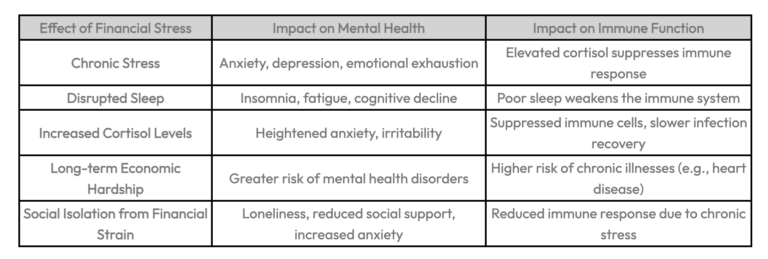
When we’re under prolonged stress, especially around money, our mental bandwidth shrinks. Stress takes up space in our minds — not just emotionally, but cognitively — so we have less capacity to think clearly, plan well, or make calm decisions. That’s not a lack of willpower — it’s science. Persistent worry actually competes with the brain’s ability to reason and evaluate options objectively.
This creates a cycle that’s hard to see while you’re in it:
You worry about money.
That worry lingers in the background of every thought.
Your brain starts running on autopilot to conserve energy.
Decision-making becomes reactive instead of thoughtful.
Researchers have found that when financial stress is high, people show higher levels of psychological distress — worry, anxiety, emotional exhaustion — and this is not just “feeling stressed,” it’s a measurable connection between financial strain and mental health.
There’s also a name for the kind of thinking that wears you down without you even realizing it: in psychology it’s called perseverative cognition — the brain repeatedly replays negative thoughts and worries about money or the future. Over time, this activates the stress response system continuously, so it feels like you’re never truly “off.”
The result? We make choices that feel easier in the moment (because we’re exhausted), but those same choices often make the stress cycle worse — not better. That’s why financial burnout doesn’t always feel like “bad decisions,” it feels like survival decisions.
None of this means you’re weak or behind. It means your brain — just like everyone else’s — is wired to protect you first, sometimes in ways that don’t actually help long-term.
What I’m Doing Differently Now (Without Hustling Harder)
What Recovery Actually Looks Like Right Now
For a long time, I thought the answer to money stress was more effort. More productivity. More pushing. What I’m learning now is that recovery doesn’t start with doing more — it starts with doing less on purpose.
The biggest shift I’ve made is slowing my decision-making down. Not avoiding decisions, but refusing to make them from a place of panic. If something feels urgent but not necessary, I let it wait. If a choice requires energy I don’t have, I give myself permission to come back to it later.
I’ve also stopped treating every idea as a solution. When you’re burned out, every new plan feels like hope — and that’s dangerous. Right now, my focus isn’t growth or optimization. It’s stability. Fewer tools. Fewer subscriptions. Fewer moving parts competing for my attention.
Another change has been separating earning from repairing. Not every hour needs to generate income, and not every financial issue needs to be solved immediately. Some things just need time, consistency, and space to settle. Letting those two processes coexist — instead of forcing them to fix each other — has eased more pressure than I expected.
Most importantly, I’m paying attention to my capacity. If I’m exhausted, I don’t make financial commitments. If I’m overwhelmed, I don’t try to outthink the problem. Rest isn’t a reward for getting everything right — it’s part of staying steady enough to make better choices.
This phase isn’t flashy. It won’t make for dramatic before-and-after photos. But it feels sustainable. And right now, that matters more than anything else.
🌱 A Gentle Reset Checklist (What I’m Actually Doing)
This isn’t a “fix everything” list.
It’s a stability checklist — the kind you return to when money burnout flares up.
☐ Pause major financial decisions when I’m exhausted
☐ Limit active projects to what I can realistically manage
☐ Review subscriptions and tools (not cancel everything — just notice)
☐ Separate income-building time from money-repair time
☐ Check finances without judgment or spiraling
☐ Choose rest before making commitments
☐ Allow progress to be quiet and unremarkable
Recovery doesn’t have to look impressive to be effective.
Some weeks I check off one thing. Some weeks I check off none. Both are okay.
Redefining Progress When You’re Burned Out
When you’re dealing with money burnout, it’s easy to overlook progress because it doesn’t look dramatic. We’re conditioned to believe improvement should be visible, measurable, and fast. But burnout recovery rarely works that way.
Some of the biggest wins in this season don’t show up on spreadsheets.
It’s opening your banking app without immediately closing it again.
It’s paying one bill on time after weeks of avoidance.
It’s having an honest conversation instead of pretending everything is fine.
It’s choosing not to make a financial decision when you know you’re too tired to think clearly.
These moments may feel small, but they’re not. They’re signs that your nervous system is starting to feel safer — and safety is what makes better decisions possible over time.
I’m learning that progress isn’t about catching up. It’s about steadying yourself enough to stop sliding backward. Some weeks that means tangible movement. Other weeks it just means maintaining where you are. Both count.
Money burnout doesn’t resolve all at once. It loosens gradually, through consistency, compassion, and patience. And the quiet wins — the ones no one claps for — are often the ones that matter most.

A Simple Check-In for Money Burnout Days
When money stress feels overwhelming, clarity usually isn’t the problem — capacity is. Instead of asking “What should I do?”, I’ve started asking myself three gentler questions:
What feels heavy right now?
(A bill, a decision, a conversation, a sense of uncertainty.)What’s the smallest safe action I can take today?
(Not the perfect step — just the one that reduces pressure.)What can wait without making things worse?
(Because not everything needs your attention at once.)
Sometimes the answer is paying something.
Sometimes it’s sending one email.
Sometimes it’s choosing rest so tomorrow’s decisions are better.
None of these answers are wrong.



Closing Thoughts: You’re Not Behind — You’re Recovering
If you’re reading this and quietly recognizing yourself in these words, I want you to know this: money burnout isn’t a personal failure. It’s what happens when responsibility, pressure, and exhaustion stack up for too long without relief.
You don’t need a perfect plan to start recovering. You don’t need to fix everything at once. What you need is enough steadiness to make one kind decision at a time — for your finances and for yourself.
Progress in this season may look slower than you’d like. It may feel unimpressive. But choosing clarity over panic, rest over reaction, and patience over pressure is not nothing. It’s the foundation everything else builds on.
I’m still in this process. Some days feel lighter than others. But I’m learning that recovery isn’t about getting back to who I was before — it’s about moving forward with more care than I had then.
If money burnout has been part of your story too, you’re not alone. And you’re not failing. You’re finding your footing again.
If this resonated, I’d love to know — what does “progress” look like for you right now?